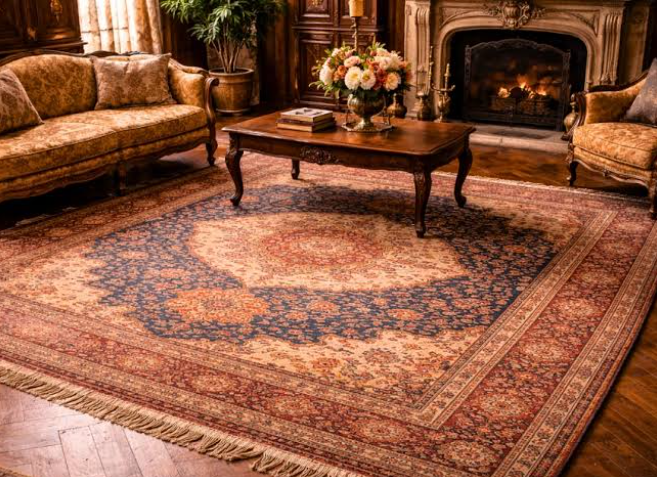
Authentic traditional rugs are hand-knotted from natural fibers like wool or silk, feature slight design imperfections, have integrated fringes, and come from regions with established weaving traditions. Checking material quality, knot density, and seller credentials are the fastest ways to verify a rug’s authenticity before you buy.
Buying a traditional rug is a significant investment. A genuine handmade rug can last decades, hold its value, and bring real character to a room. A machine-made imitation? It looks similar for about two years—then falls apart.
The problem is that the rug market is full of products positioned as “authentic” or “handmade” that are neither. Sellers use vague language, and most buyers don’t know what to look for. That gap leads to expensive mistakes.
This guide gives you a clear, practical checklist. By the end, you’ll know exactly what separates a real traditional rug from a convincing fake—and what questions to ask before you buy rugs of any kind.
Why Authentic Traditional Rugs Are Worth the Attention
Handmade rugs in India—and across the broader South Asian region—represent centuries of craft. A single hand-knotted rug can take months or even years to complete. Artisans use techniques passed down through generations, working with natural materials and traditional design patterns that carry cultural meaning.
That craftsmanship creates something a machine cannot replicate: variation, texture, and depth that genuinely improves with age. Authentic rugs also tend to hold their value better than machine-made alternatives, making them worthwhile purchases for both home use and long-term investment.
Key Indicators of Authenticity in a Traditional Rug
What materials reveal about a rug’s quality
The first thing to check is the fiber. Authentic traditional rugs use natural materials—wool, silk, or cotton. Wool is the most common; it’s durable, naturally stain-resistant, and develops a soft sheen over time. Silk adds a fine texture and a subtle luster that shifts under different lighting. Cotton is typically used for the foundation structure rather than the pile.
Synthetic fibers like polyester or nylon look similar at first glance, but they feel different. Wool has a slight natural roughness. Synthetic pile feels uniform and often slightly slippery.
Dye consistency matters too. In authentic rugs, colors shift slightly across the surface—a phenomenon called abrash. This happens because artisans dye wool in batches, and each batch absorbs color a little differently. Machine-made rugs use uniform dyes that produce perfectly consistent, flat color. Paradoxically, slight color variation is a good sign.
How weaving technique separates real from fake
Turn the rug over. On a genuine hand-knotted traditional rug, you can see individual knots tied around the warp threads. The pattern on the back mirrors the pattern on the front—slightly softer, but clearly visible.
Machine-made rugs have a backing material glued or stitched onto a uniform base. The back looks clean and grid-like, often with a canvas or latex layer hiding the construction.
Knot density—measured in knots per square inch (KPSI)—indicates craftsmanship level. Higher knot density generally means finer detail and more labor. A basic tribal rug might have 40–80 KPSI. A fine silk rug from a skilled weaving center can exceed 300 KPSI. Ask the seller specifically about knot density; reputable dealers will have this information.
What design patterns tell you
Traditional rugs follow motifs with regional and cultural significance. Persian rugs use floral medallions and intricate botanical patterns. Tribal rugs from Central Asia feature geometric shapes and repeating symbols. Indian rugs—particularly those from the Bhadohi region—blend Mughal-influenced florals with contemporary design sensibilities.
Authentic hand-knotted rugs always carry minor imperfections. A border that’s slightly uneven, a motif that shifts a few millimeters—these are signs of a human hand at work, not a flaw. If a rug’s pattern is perfectly symmetrical and machine-precise, it likely came from a machine.
What to check at the fringe and edges
On a genuine hand-knotted rug, the fringe is an extension of the warp threads that run through the entire rug. It’s not sewn on afterward—it grows directly from the rug’s structure.
If the fringe is glued, stitched, or attached separately, the rug is almost certainly machine-made or a low-quality hand-tufted piece. Similarly, authentic rugs have hand-bound edges (called selvages) that wrap tightly around the outermost warp threads. Machine-made edges look uniform and often have visible stitching along a straight seam.
Origin and Craftsmanship: Where Handmade Rugs in India Come From
India has one of the richest rug-weaving traditions in the world. Bhadohi, a town in Uttar Pradesh, is recognized as South Asia’s largest hub for hand-knotted carpet weaving. Artisans in this region have practiced the craft for centuries, producing rugs that export globally.
Jaipur, Agra, and Kashmir are other major centers, each with distinct regional characteristics. Kashmiri rugs, for instance, often use fine silk and feature intricate Persian-influenced patterns. Rajasthani rugs tend toward bolder, geometric designs with durable wool pile.
When you buy handmade rugs in India—or rugs sourced from Indian weaving traditions—ask about the specific region of origin. Reputable sellers can tell you where the rug was made, what weaving method was used, and who the artisans were. That level of detail is a strong authenticity signal.
Artisans are central to this process. Organizations like The Ambiente, a rug atelier founded in Bhadohi and backed by over 30 years of expertise through its parent company Bhadohi Carpets, work with more than 4,000 skilled weavers—the majority of whom are women. This direct connection between brand and artisan is something worth looking for when choosing where to buy rugs.
Where to Buy Authentic Traditional Rugs
Reputable dealers invest in their supply chain. They can trace a rug’s origin, name the weaving technique, and provide documentation or certification of authenticity. They don’t use vague terms like “handcrafted-style” or “hand-finished”—language that deliberately obscures whether a rug is actually hand-knotted.
The Ambiente, with its flagship store in Sultanpur, New Delhi, and collections available for both in-person and online purchase, is an example of a design-led rug brand that combines traditional Indian craftsmanship with transparent sourcing. Founded by Avani Khandelwal—an MBA graduate with deep roots in the Bhadohi carpet industry—the brand serves over 5,000 clients in India and abroad, offering bespoke and ready-to-ship hand-knotted wool and silk rugs.
Whether you shop locally or online, prioritize sellers who give you specific, verifiable information about their products.
Avoiding Fakes: Common Deceptive Practices
Some sellers use terms like “hand-made” to describe hand-tufted rugs—a category where the pile is punched through a canvas backing using a handheld tool. Hand-tufted rugs are faster to produce and significantly cheaper, but they don’t last as long as hand-knotted rugs. The canvas backing deteriorates over time, and the pile often sheds heavily in the first few years.
Other common tactics include:
-
Artificial aging: Chemical washing to make a new machine-made rug look vintage
-
Misleading labels: “Oriental-style” or “Persian-inspired” phrasing that suggests a regional origin without confirming it
-
Vague provenance: No specific information about where or how the rug was made
Questions to ask before you buy rugs
Before committing to a purchase, ask the seller these directly:
-
Is this rug hand-knotted, hand-tufted, or machine-made?
-
What fibers were used in the pile and foundation?
-
What is the knot density (KPSI)?
-
Where was the rug made, and by whom?
-
Are the dyes natural or synthetic?
-
Does the fringe extend from the warp threads, or is it attached separately?
A seller who can answer these questions confidently and specifically is worth trusting. Hesitation or vague responses are a warning sign.
Make the Right Call Before You Buy
Authentic traditional rugs reward careful buyers. The signs are consistent: natural fibers, hand-knotted construction, slight design imperfections, integrated fringes, and a seller who knows their product in detail. Machine-made and hand-tufted alternatives can look similar on the surface, but they don’t hold up over time—and they don’t carry the cultural and artisan value that makes a real traditional rug worth owning.
Use the checklist in this guide every time you shop. Ask the hard questions. And when you find a rug from a reputable source—whether it’s handmade rugs in India or from another established weaving tradition—you’ll know exactly what you’re getting.
Frequently Asked Questions
How can I tell if a traditional rug is hand-knotted or machine-made?
Turn the rug over. A hand-knotted traditional rug shows individual knots tied around the warp threads, with the pattern visible on the back. A machine-made rug has a uniform backing—often latex or canvas—that hides the construction. The back of a hand-knotted rug looks slightly irregular; a machine-made back looks perfectly neat and grid-like.
What fibers should an authentic traditional rug be made from?
Authentic traditional rugs use natural fibers: wool, silk, or cotton. Wool is the most common pile material. Silk is used in finer, higher-value pieces. Cotton often forms the structural foundation. If a rug is made from synthetic fibers like polyester or polypropylene, it is not a genuine traditional rug.
Are imperfections in a rug’s design a bad sign?
No—minor imperfections are actually a positive indicator of authenticity. Hand-knotted rugs are made by human artisans, so slight variations in symmetry, color (known as abrash), or pattern are normal. A perfectly uniform design with no variation typically signals machine production.
What does knot density mean, and why does it matter when buying rugs?
Knot density measures how many knots appear per square inch (KPSI) in a hand-knotted rug. Higher knot density means finer detail and more labor. Basic rugs may have 40–80 KPSI, while fine silk rugs can exceed 300 KPSI. Asking a seller about KPSI is one of the fastest ways to assess quality and craftsmanship.
Why are handmade rugs in India considered high quality?
India—particularly the Bhadohi region in Uttar Pradesh—is one of the world’s most established centers for hand-knotted rug production. Artisans there have practiced the craft for centuries, using techniques refined over generations. Cities like Jaipur, Agra, and Kashmir each have distinct weaving traditions, producing rugs that meet international quality standards and are exported globally.
What is the difference between hand-knotted and hand-tufted rugs?
A hand-knotted rug is made by tying individual knots around warp threads—a slow, highly skilled process that can take months. A hand-tufted rug is made by punching pile yarn through a canvas backing with a handheld tool, then covering the back with a glued fabric layer. Hand-tufted rugs are cheaper and faster to produce, but they don’t last as long and lack the craftsmanship value of hand-knotted pieces.


