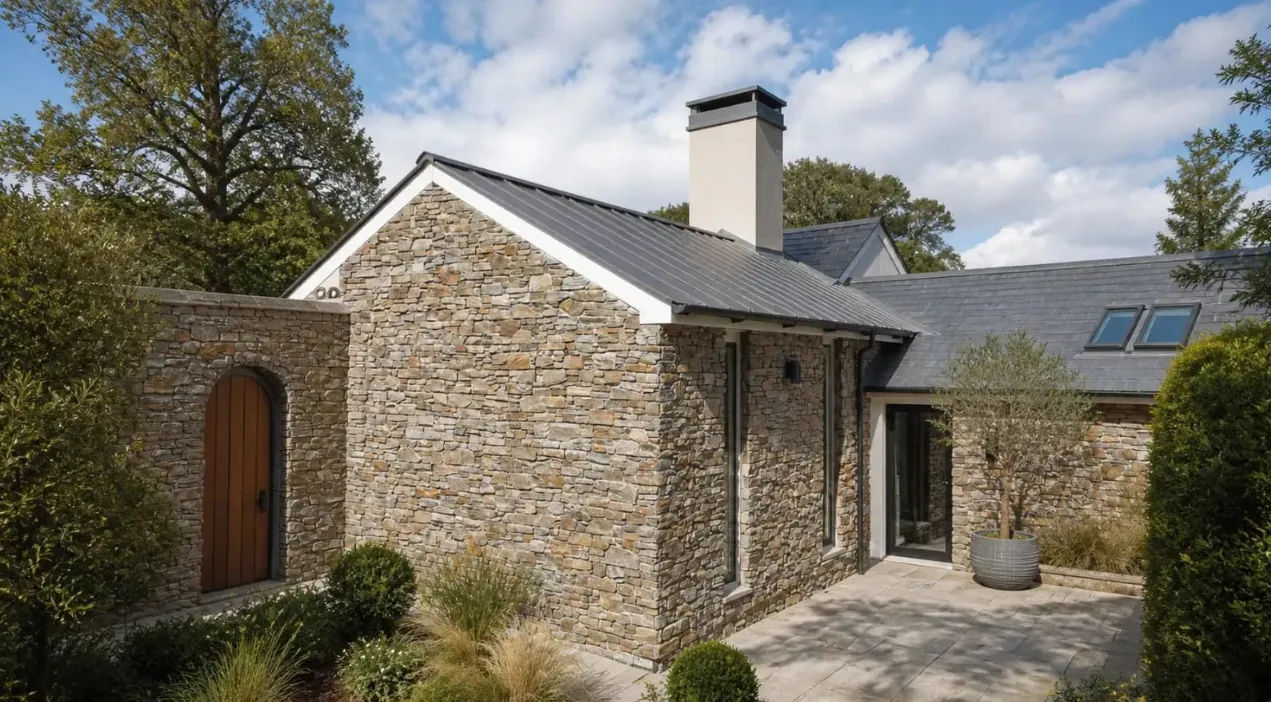
Natural stone cladding is increasingly being used as more than simply a wall covering. In well-planned exterior projects, it can become an architectural feature that connects a house with its garden, defines an entrance, adds texture to a courtyard or provides a natural contrast to modern render, glass and paving.
One of the most distinctive formats is stone cladding Z panels. Their staggered format and deeply textured natural stone faces can create the appearance of individually stacked stone while giving designers considerable freedom to use the material on both traditional and contemporary properties.
The following ten ideas show how stone wall cladding can be used creatively across residential gardens, entrances and exterior architectural features.
1. Create a Statement Garden Wall
A large garden wall is one of the best places to use strongly textured natural stone. Instead of treating the wall simply as a boundary, it can become one of the main visual elements within the landscape.
Stone works particularly well behind planting because the irregular mineral surface contrasts naturally with foliage. Green plants soften the hard material, while the stone provides a permanent background throughout the year.
Good Locations for a Stone Garden Wall
- Behind a patio seating area
- Along a garden boundary
- Behind raised planting beds
- At the end of a long garden
- Beside a terrace or courtyard
For larger walls, colour variation becomes particularly important. Natural differences between individual pieces can create movement across the surface and prevent the wall from appearing too uniform.
2. Use Stone Cladding to Define the Front Entrance
The front entrance is often the strongest architectural focal point of a house. A relatively small area of stone cladding can therefore have a disproportionately large visual impact.
Instead of covering the entire front elevation, stone can be concentrated around the doorway, porch or entrance columns. This creates a clear visual destination and distinguishes the entrance from the surrounding brick or render.
For a Modern Entrance
Black, charcoal, blue-grey and cooler grey stone can work effectively with anthracite doors, aluminium frames and white or pale-grey render.
For a Traditional Entrance
Warmer gold, brown, buff and multicolour stone can sit naturally beside traditional brickwork, timber doors and established planting.
3. Combine Stone Wall Cladding with Modern Render
One of the most effective contemporary combinations is strongly textured natural stone beside smooth render.
The materials are visually very different. Render creates a clean, continuous surface, while stone provides irregular texture, shadow and natural colour variation. Used together, each material makes the other more noticeable.
Rather than dividing the building randomly, designers can use stone to identify specific architectural zones such as:
- The entrance
- A projecting section of the house
- A ground-floor feature wall
- A garden-facing elevation
- A chimney or vertical architectural feature
This selective approach can be more visually effective than covering the entire building in one material.
4. Build a Stone-Clad Outdoor Kitchen
Outdoor kitchens have become an increasingly important part of garden design. Permanent cooking areas, counters and islands often need a finish that feels more substantial than painted blockwork or lightweight decorative panels.
Natural stone cladding can give an outdoor kitchen the appearance of a permanent landscape structure while allowing it to coordinate with nearby walls and paving.
Stone Can Be Used Around
- Barbecue structures
- Kitchen islands
- Preparation counters
- Outdoor bars
- Raised seating areas
- Adjacent feature walls
Using the same stone on more than one vertical element can help connect different parts of the outdoor living area without requiring every surface to match exactly.
5. Turn a Plain Courtyard into a Textured Space
Courtyards are particularly well suited to natural stone because walls are viewed from relatively short distances. At close range, the depth and mineral character of the stone become much more noticeable.
A single stone-clad wall can transform an enclosed courtyard without making the space feel overloaded. The remaining walls can stay rendered, painted or built from brick, allowing the natural stone to act as the focal surface.
The broader range of natural stone wall cladding makes it possible to choose colours ranging from warm gold and multicolour stone to cooler grey and darker architectural finishes.
6. Combine Stone Cladding with Exterior Lighting
Lighting can completely change the appearance of deeply textured natural stone after dark.
When light travels across the surface rather than directly towards it, projecting stone pieces create bright highlights while recessed sections remain in shadow. This exaggerates the three-dimensional character of the wall.
Effective Lighting Locations Include
- Above entrance walls
- At the base of garden feature walls
- Beside stone-clad pillars
- Around courtyard seating areas
- Along outdoor kitchens
The result can be very different from the wall’s daytime appearance, effectively giving the same material two separate visual characters.
7. Use Stone to Connect an Extension with the Garden
Modern extensions often contain large areas of glazing and open directly onto patios or terraces. This creates an opportunity to use one material as a visual connection between the building and the landscape.
Stone cladding can be introduced on part of the extension and then repeated on a nearby garden wall, outdoor kitchen or raised landscape feature.
The stone does not have to dominate either area. Repeating it selectively can be enough to create visual continuity between the architecture and the garden.
A Typical Material Combination Might Include
- Natural stone wall cladding
- Large glazed doors
- Porcelain or natural stone paving
- Rendered walls
- Timber or composite fencing
- Structured planting
8. Pair Stone Cladding with Contrasting Paving
A common design mistake is assuming that wall stone and paving must match exactly. In many projects, controlled contrast creates a stronger result.
Dark Stone with Pale Paving
Black or charcoal stone can provide a strong vertical backdrop to pale grey, cream or beige paving.
Warm Stone with Neutral Grey Paving
Gold, brown and buff wall stone can introduce warmth into a garden dominated by neutral paving and contemporary furniture.
Cool Grey Stone with Modern Porcelain
Grey and blue-grey stone can complement contemporary porcelain paving without requiring both materials to have precisely the same shade.
The objective is usually to create a coordinated palette rather than make every material identical.
9. Give Boundary Walls More Architectural Character
Boundary walls occupy a large amount of visual space in many gardens but are often treated as purely functional structures.
Natural stone cladding can turn these walls into part of the overall landscape design. This can be particularly effective where the wall is visible directly from the house or forms the backdrop to a main patio.
It is not always necessary to clad the entire boundary. Selected sections can be used to create focal points, frame planting or identify different garden zones.
Possible Treatments Include
- One central stone feature wall
- Stone-clad pillars between other wall finishes
- A stone section behind a seating area
- Stone surrounding a water feature
- Stone around an outdoor fireplace
10. Use Stone Cladding as a Bridge Between Traditional and Contemporary Design
One reason natural stone remains so useful is that it does not belong exclusively to one architectural period.
The same material can appear traditional when combined with brick, clay roof tiles, timber and informal planting, yet look highly contemporary beside large glazing, smooth render and dark metal frames.
This makes natural stone particularly useful when renovating or extending an older property. Instead of attempting to make every new material imitate the original building, stone can provide a visual bridge between old and new.
Think About Texture as Well as Colour
Colour often receives most of the attention when choosing stone, but surface depth can be equally important.
Strongly projecting natural stone creates more shadow and therefore has greater visual presence. A highly textured wall may look dramatic even when the stone itself uses relatively neutral colours.
This becomes particularly important on:
- Large uninterrupted walls
- Entrance features
- Walls illuminated at night
- Courtyards viewed from close range
- Feature walls behind outdoor seating
Allow Natural Stone to Look Natural
Natural stone should not be expected to have the uniform appearance of a printed tile or manufactured panel. Individual pieces may vary in colour, mineral markings, surface depth and texture.
Rather than attempting to eliminate this variation, good design normally uses it as part of the finished appearance.
When working across a larger wall, distributing darker, lighter and more strongly marked pieces throughout the installation can create a more balanced overall result.
Use Corners as Part of the Design
Corners deserve particular attention because they can reveal whether a wall has been thoughtfully designed.
Where stone is intended to create the impression of substantial masonry, abrupt flat edges can weaken the effect. Well-planned corner treatment helps the material appear to continue naturally around the structure.
This is particularly noticeable on:
- Entrance pillars
- Outdoor kitchen islands
- Freestanding garden walls
- Porches
- Chimney features
Do Not Overuse the Material
Natural stone has strong visual character. This means more is not always better.
In many contemporary projects, one carefully positioned stone wall can be more effective than covering every elevation. The surrounding simpler materials provide visual space for the natural texture to stand out.
A useful design principle is to decide what the stone is intended to achieve before deciding how much of it to use.
The Stone Might Be Intended to
- Identify the entrance
- Frame a garden view
- Create a backdrop to planting
- Connect a house with its landscape
- Introduce texture into a modern elevation
- Make an outdoor kitchen feel permanent
- Break up a large rendered wall
Choose Exterior Stone Cladding for the Actual Project
Design inspiration is important, but exterior wall materials must also suit the construction behind them. Wall type, installation height, exposure, panel weight and fixing requirements should all be considered before the final product is selected.
Homeowners and designers considering different exterior applications can review an external natural stone cladding range as part of the material-selection process.
There are also natural stone cladding panel options intended for different wall applications, so the visual design should always be considered together with the requirements of the particular installation.
Stone Cladding as Part of the Whole Landscape
The strongest exterior designs usually consider walls, paving, planting, architecture and lighting together rather than selecting each element separately.
A garden wall may contain the same warm mineral tones found in nearby paving. A grey entrance wall may echo the colour of the window frames. A dark stone feature may provide contrast against pale render while also connecting visually with black garden furniture or fencing.
These relationships do not need to be exact. In fact, slight variation often makes the finished space appear more natural.
Final Thoughts
Natural stone cladding offers far more design possibilities than simply covering an unattractive wall. It can define entrances, transform garden boundaries, create outdoor living features, connect extensions with landscapes and introduce three-dimensional texture into otherwise simple architectural surfaces.
The most successful projects usually use stone deliberately rather than everywhere. Colour, surface depth, surrounding materials, lighting and planting all influence the final result.
Whether it is used on a traditional garden wall or as a contrasting feature on a modern home, natural stone can turn an ordinary vertical surface into one of the strongest elements of the entire exterior design.