Every golf course has always incorporated into its composed mix strategy, landscape, and experience. Today, all have more; designers require this precision; it is also needed by stakeholders. Finally, golfers expect courses that are both rigidly constructed yet equally natural.
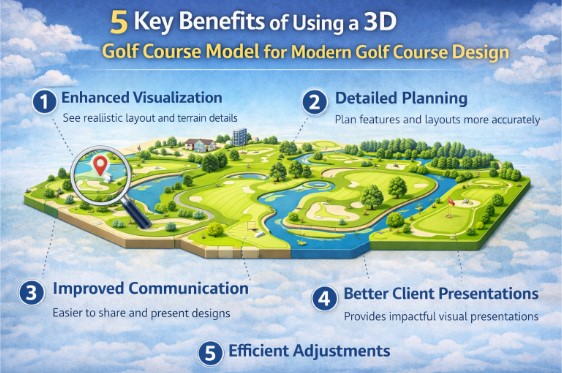
Hence, in all modern parlance, a 3D golf course model is a practical design tool of never-before-realized visual realization. This helps the team better see how a course will play even before it exists, to try out conclusions early, and to communicate an idea with clarity.
Many designers presently work with the finest 3D rendering company to achieve accuracy and flexibility while working on the designs from the very first day.
Clear Visualization of Terrain and Elevation
Land gives shape to golf courses. Slopes, contours, water bodies, and elevation changes all define how each hole plays. Traditional drawings of golf holes cannot capture this much. A 3D golf course model shows how the terrain acts.
The study of fairway slopes, green undulations, and bunker placements can all be done in context. This clarity helps in avoiding those time-consuming and costly corrections incurred by finding design flaws only after construction.
Better Shot Planning and Course Strategy
A good golf course sets up problems for the players to have to think about. Risk, reward, and access to shot selection depend fully on how the course is set up. The whole scheme becomes easy to fine-tune; the whole strategy diversity across the course becomes a matter of course.
Decisions are made on how the course plays and not just how it looks on paper. With a 3D golf course model, the designers can look at simulated sight lines, landings, and hazards around those aspects.
Faster Design Iterations and Adjustments
Whatever the project, design changes are always part of it. So, even if the change imposed is small, imagining and explaining it would probably take quite some time without a 3D model. A 3D golf course model enables quick revision of layouts, elevations, or relocations of features.
Stakeholders may be able to see alterations instantly rather than interpreting revised drawings. Working with the best 3D rendering company allows smoother iterations to flow unencumbered by any confusion.
Stronger Communication With Stakeholders
A golf course is much more than a conceptual design or site plan: It includes owners, investors, architects, environmental consultants, and, in some cases, local authorities. Not everyone interprets all those technical drawings and scribbles that form a concrete way of presenting visuals as a vernacular or pictorial language.
A 3D model has been visualized as a lingua franca among stakeholders, walking through the course virtually, seeing and understanding the design intent, and giving much improved and informed feedback. Fewer misunderstandings and quicker approvals lead to more confidence in the ultimate design.
Environmental and Sustainability Planning
Contemporary golf course designs should adhere to the landscape. Drainage, water usage, vegetation, and environmental impact are very important key elements. A three-dimensional (3D) model of the golf course can assist the designers in getting the course to get along with the surroundings.
Water flow, natural contours, and placement of greens can be studied in early stages. This supports smarter environmental decisions and helps develop a balance between playability and sustainability goals.
Supporting Construction Accuracy
The intent of the design may not be transferred through the construction if there is an absence of a sharp visual representation. Therefore, a highly detailed 3D model will act throughout the build as a reference.
The contractors will be able to understand the grading and shaping, and where the features have to be placed accurately. Hence, it reduces uncertainty in construction on-site and paves a path to maintaining construction according to the original vision. Clear visuals lead to better execution and a reduction in changes during the construction phase.
Long-Term Value Beyond Design
A 3D model of a golf course can continue to be used even after the design approval process has been completed, for marketing purposes, member presentations, renovations, and future upgrades.
The same model can be updated over time as the course changes. This makes it more of a long-term asset than a one-time charge design cost.
Conclusion
Modern golf course design requires clearness, flexibility, and precision; a 3D golf course model provides all three by helping designers realize concepts through terrain understanding, refining their strategies, clarifying their communications, and constructing more confidently.
Support in manufacturing from the best 3D rendering company makes these models “must-have” tools for better decision-making at every stage. It will show not only what the course will look like but also how it will play, feel, and survive in the years to come.