In the rail industry, safety, accuracy, and dependability are guiding operating factors. As rail lines expand and more sophisticated operating systems come in, having qualified operators in the cockpit of every train is a strategic goal.
No longer can classroom-style training, working on a handful of manuals, and training with a handful of trainees, in the initial periods of an operator‘s career, adequately provide rail employees with the skills they need daily.
Traditional Train Operator Training Lacks in Certain Ways
Most traditional railway simulator operators work by classroom training, in addition to real-world operation with actual trains. This has its advantages; however, it’s not always resourceful and can be dangerous at times. Training inside an actual train can be dangerous if you make a mistake, and costly in some of the services. Real instruction by staff can be an enormous amount of money, and scheduling can be difficult.
Also, many of the most serious situations can be hard to replicate, such as signal failure and emergency braking without endangering a life. The variance in training variety can result in inconsistency from instructor to instructor and from facility to facility. An electronic system with preset scenarios can reduce these problems.
Immersive Technology as a Benefit to Rail Worker Education
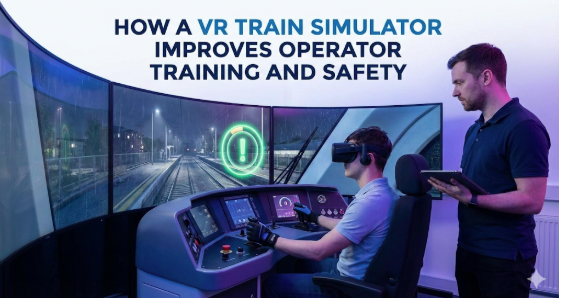
The virtual environment puts the operators into a computer-generated representation of the rail system. Unlike a static simulation, the console is capable of generating surround sound as well as a HMD headset to induce full immersion into a world that is as tangible as the World. This enhances the understanding and the feeling in learning and muscle memory.
There is a railway VR train simulator, which can represent control panels, rails, signals, and trains in a virtual space. Railway workers can rehearse their techniques without the risk of losing anything. Old-world phenomena can be rapidly and safely simulated, ensuring that full training only results in positive feedback.
Simulating Danger for Better Safety
One of the advantages of a virtual reality training environment is the capability to display emergencies, obstacles, and bad weather conditions in a reliable and safe way. Tramway workers can recognize system faults or signals safely. As a result, there will be fewer human error accidents.
Having a VR simulator component in an operator trainer’s bundle means that data can be collected from the users’ responses, and improvements can be pinpointed on weak points in the system. Human error can be learned from and acted upon before accidents occur.
Using 3D Modeling to Animate an Environment
Intros and overs wherever high-end virtual rail environments are needed will employ dozens of talented 3D modellers. These high-end artists produce colourful demonstrations of high-end train dashboards, moving station and track images, and a/or signaling and terminal hardware.
The more responsive the virtual world is, the quicker the rail organisation is likely to adapt by visualising the right images safely. And realistic 3D dashboard dials and dispatch hardware allow truthful fingers, on instruction. This exposes the training operator to the genuine items you would see in the cockpit.
Make Training Repeatable and Defined
A significant benefit of simulation is focused lessons that are repeatable and scalable. The program can be made uniform for each learner, so there‘s no difference in competency. Still, even with this, the program continues to be scalable; the virtual simulator system can be used in many locations without problem.
Moreover, should a new engine or route come online, the simulation engine can be altered to reflect this. The virtual reality environment is to grow and adapt as time progresses. Through the utilisation of evaluation information that VR provides, a trainer can determine the operational success of an operator and adapt or modify accordingly to seek out the most educated and safest rail operator.
The Cost-Effectiveness of VR Train Simulators
One of the major drawbacks of putting a virtual reality element into a training situation is the expense; this is offset by savings over time. Mistakes are reduced, safety is improved, and resources are preserved by the decreased use of virtual vehicles. Learning is achieved more rapidly because there isn‘t a transition into the virtual session. With data gained from the use of a VR element, specialists can streamline on-board training programs and minimise safety concerns for as long as they run.
Conclusion
Along with (or perhaps even before) advances in rail technology, there is the necessity for more comprehensive and repeatable forms of operator training. A VR train simulator puts an operating learner into a very realistic learning situation. By means of (among other things) 3D modeling services, metrics can be collected to ensure higher-quality rail worker training and a safer environment.